Building client relationships is the foundation for any business. CRM solutions help you track interactions, automate follow-ups, and stay organized. Demand for these platforms continues to grow, with Statista forecasting 9.8% annual growth through 2030 as more businesses see the value of centralizing client data and workflows.
The right CRM sets your real estate business up for success. It handles the tracking and reminders so you can focus on conversations instead of worrying about missed opportunities.
Here are our recommendations for the best CRM for real estate investors in 2026.
10 best CRM platforms for real estate investors
Some of the best CRM options for real estate investing include:
1. Agora
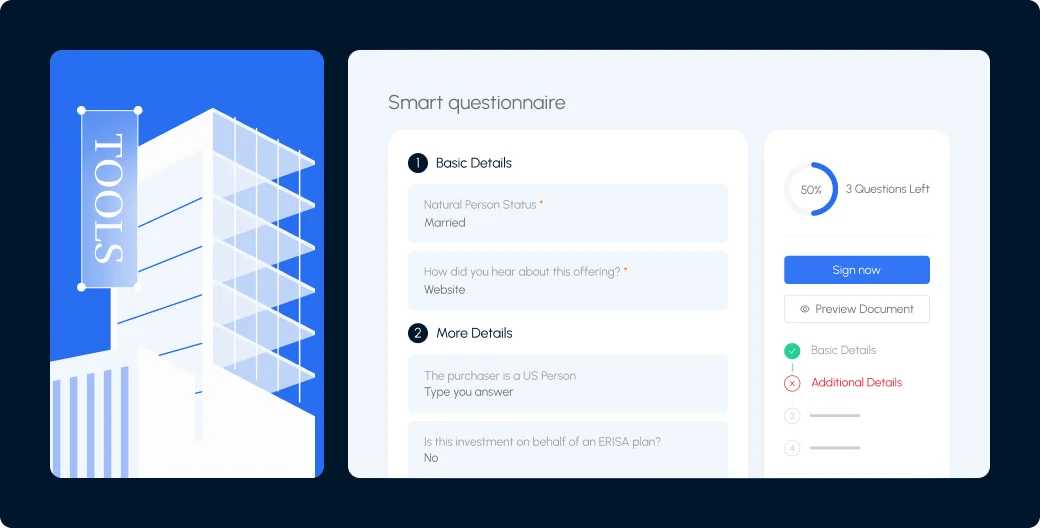
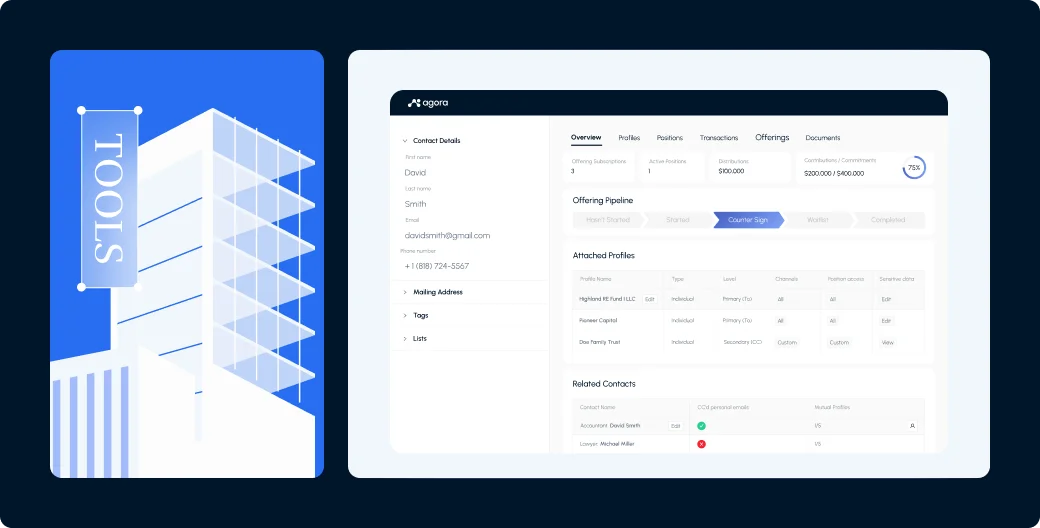
Agora is an investment management platform for commercial real estate firms with an integrated CRM to support fundraising, communications, reporting, and distributions. Key features include automating the investor lifecycle from prospect tracking through onboarding and ongoing relationship management.
CRE investment firms can organize investors by accreditation, geography, or deal involvement. Automated workflows like document collection and follow-ups, along with secure portal access to reports and tax documents, reduce manual work for investor relations teams.
Pricing: Starts at $749/month. Pro and Enterprise plans available with custom pricing.
Best for: Commercial real estate firms managing investor relationships, capital raising, and ongoing reporting and distributions.

2. REsimpli
REsimpli is a real estate CRM and operations platform that combines lead management, communication tools, and marketing automation into a single system. It includes AI-assisted lead interaction, skip tracing, and performance tracking designed for investors managing high volumes of prospects.
Pricing: Basic $149/month, Pro $299/month, Enterprise $599/month.
Best for: Independent investors, wholesalers, and small teams sourcing off-market deals and managing prospect pipelines.
3. REI BlackBook
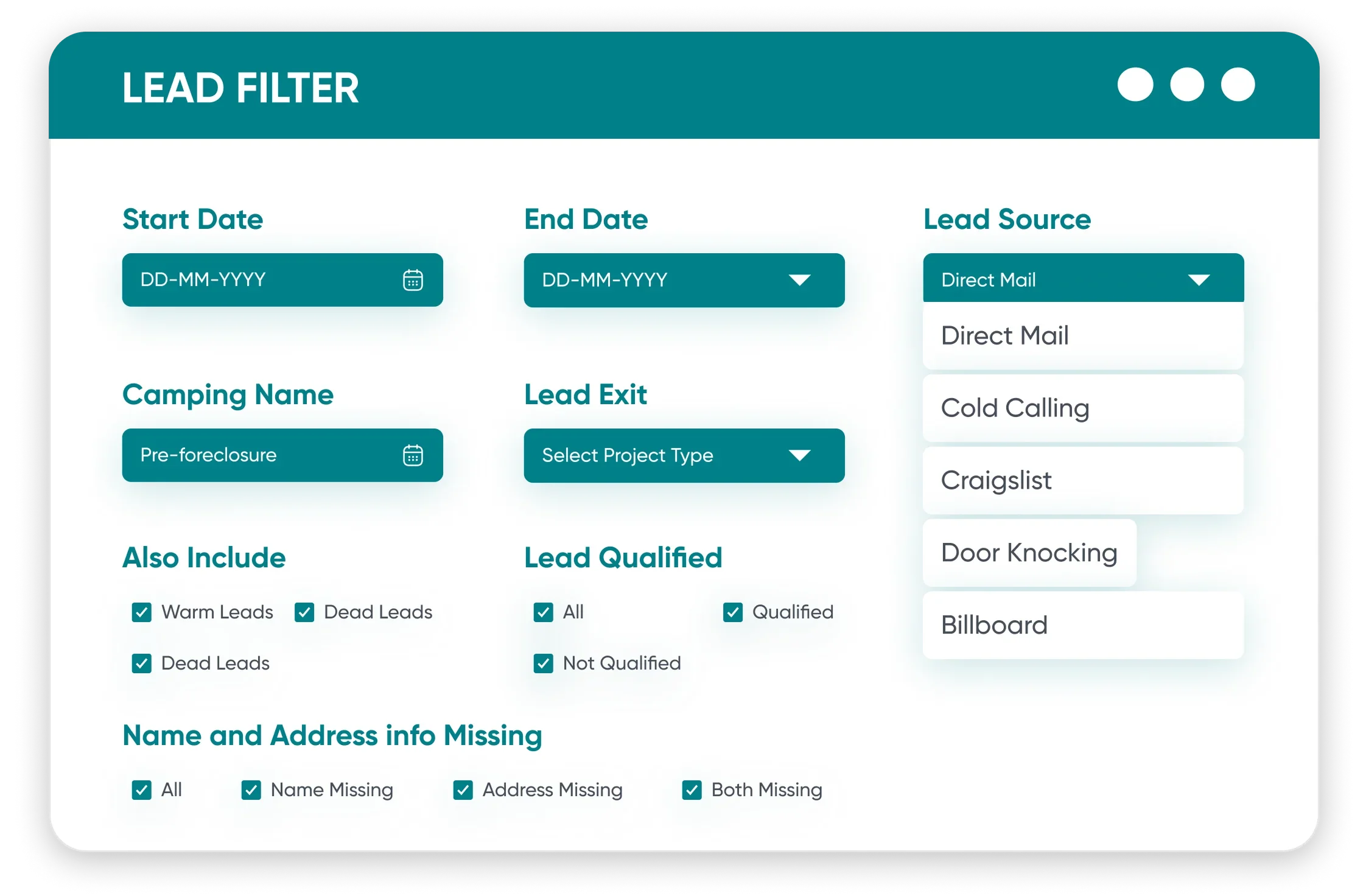
REI BlackBook is a real estate investor CRM that handles lead capture, contact management, and deal pipeline tracking. It includes built-in phone and messaging, automated follow-up sequences, and mobile access to manage contacts and workflows on the go.
Pricing: Basic $97/month, Growth $197/month, Professional $297/month.
Best for: Real estate investors and wholesalers who need lead capture, marketing automation, and pipeline management in one platform.

4. InvestorFuse
InvestorFuse is a lead conversion real estate CRM software built for structured follow-up processes and team accountability. It centralizes leads from multiple sources, automates task assignment and workflows, and tracks team performance to help investors convert more prospects into deals.
Pricing: Essentials $147/month, Pro $247/month, Premium $377/month.
Best suited for: Real estate professionals and acquisition teams managing high volumes of leads that require structured follow-up processes.

5. DealMachine
DealMachine provides a lead generation app that supports investors looking for off-market properties by driving for dollars. It includes owner contact data, automated outreach sequences, and basic CRM tracking to help investors connect with motivated sellers directly from their phone.
Pricing: Starter $99/month, Pro $149/month, Pro Plus $232/month.
Best for: Wholesalers and investors focused on sourcing deals through direct mail and cold calling.

6. PropStream
PropStream’s real estate data and lead generation platform provide nationwide property intelligence, owner contact details, and marketing tools. It combines property research with lead management to build targeted lists based on equity, tax status, or vacancy, then reach owners through email campaigns and direct mail.
Pricing: Essentials $99/month, Pro $199/month, Elite $699/month.
Best for: Investors and agents who prioritize property research and lead discovery with basic CRM outreach tools built in.

7. Forefront CRM
Forefront CRM is a real estate CRM with dashboards to see sales pipelines and automate follow-up. It uses a drag-and-drop interface to track leads through deal stages, logs all communication in centralized contact records, and automates SMS, email, and task reminders.
Pricing: Starter $99/month, Pro $199/month, Elite $299/month.
Best for: Real estate investors and teams who want visual deal tracking with automated follow-up and centralized communication management.

8. Wise Agent
Wise Agent is a real estate CRM that helps brokers manage leads with built-in marketing tools and automated follow-up. It supports automated drip campaigns, advanced contact segmentation, integrated task and calendar management, and team collaboration features.
Pricing: $49/month with an enterprise plan option that requires a custom quote.
Best for: Real estate agents, brokers, and small to mid-sized teams who want an affordable all-in-one CRM with integrated marketing and lead automation.

9. Lone Wolf
Lone Wolf is a real estate technology platform with integrated CRM for managing contacts, leads, and automated follow-ups. It includes lead generation tools that capture leads from digital campaigns and deliver them into the CRM for follow-up.
Pricing: Lone Wolf doesn’t list pricing on its website. Contact sales for a custom quote.
Best for: Any real estate agency or individual team that wants CRM as part of a larger platform that handles transactions and back-office operations.
10. Pipedrive
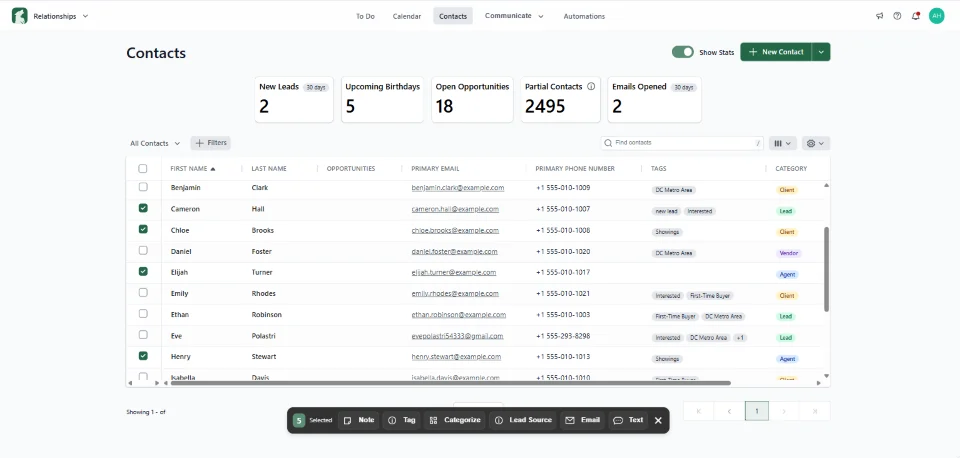
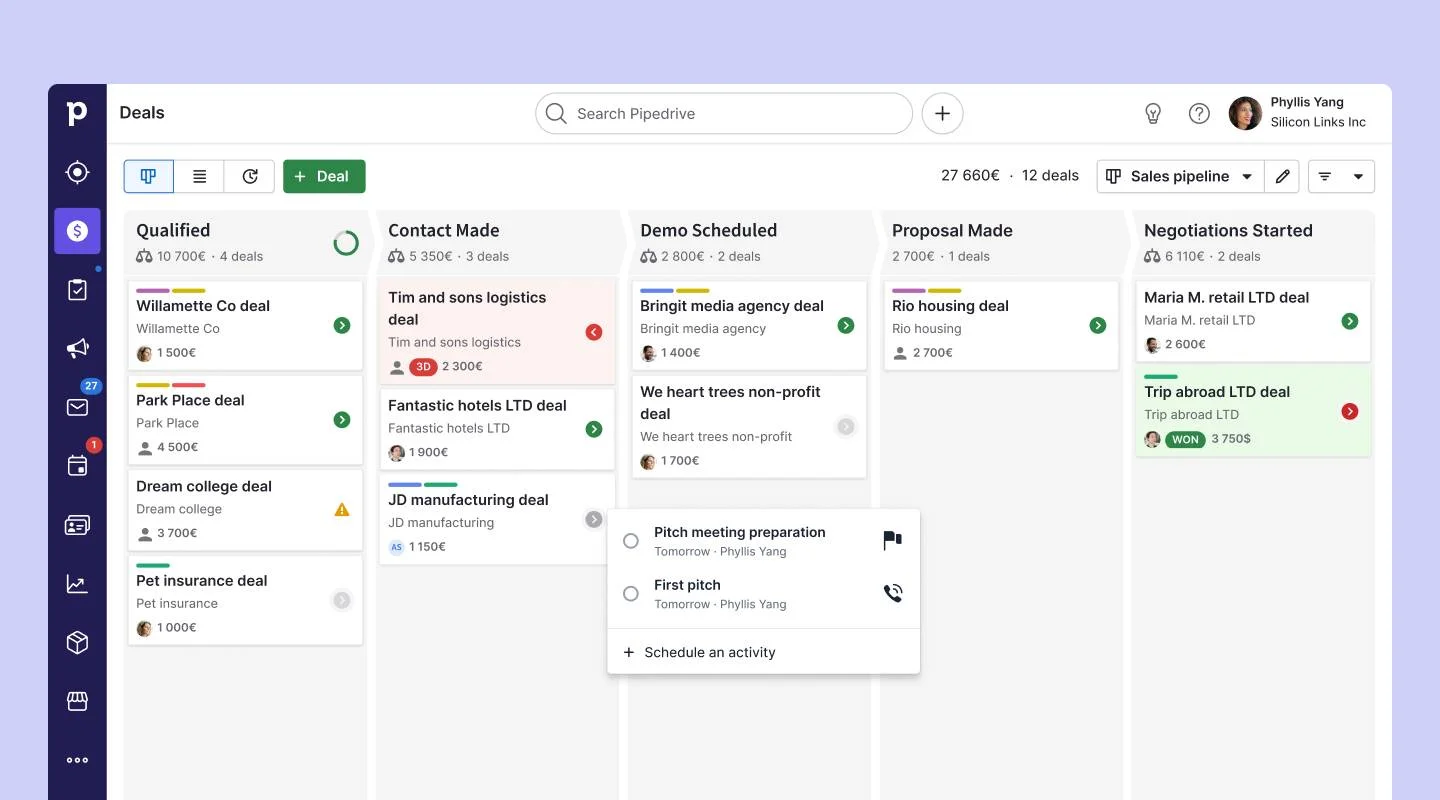
Pipedrive is a sales-focused CRM that helps teams manage contacts, track deals, and visualize pipelines with a drag-and-drop interface. It includes lead capture through web forms and chatbots, automated workflows to reduce manual updates, email integration to track client communications, and customizable reporting.
Pricing: Lite $24/month, Growth $49/month, Premium $79/month, Ultimate $99/month.
Best for: Small to mid-sized sales teams who want a simple, visual CRM to manage deals, automate routine tasks, and track pipeline health.
CRM comparison overview for real estate investors
The best CRMs help manage customer relationships while also increasing operational efficiency. Here is a comparison of each tool and its key capabilities:
| Tool | Primary focus | Key strengths | Best for |
| Agora | Investor management for CRE firms | Investor lifecycle automation, secure portal, reporting, and distributions | CRE firms raising capital and managing investors |
| REsimpli | Investor CRM + operations platform | AI follow-up, skip tracing, marketing automation | Independent investors and wholesalers |
| REI BlackBook | Investor CRM with built-in marketing | Phone and SMS integration, automated sequences | Investors needing integrated CRM and outreach |
| InvestorFuse | Structured lead conversion CRM | Centralized lead intake, workflow automation, and task management | High-volume acquisition teams |
| DealMachine | Off-market deal sourcing app | Property owner data, direct outreach, mobile-first | Wholesalers focused on cold outreach |
| PropStream | Property data + lead lists | Nationwide property intelligence, list building, email/direct mail | Individual investors, real estate agents, and lenders |
| Forefront CRM | Visual deal pipeline CRM | Drag-and-drop stages, SMS/email automation | Investors looking to track pipeline visually |
| Wise Agent | Agent CRM with marketing tools | Drip campaigns, segmentation, and calendar integration | Agents and small broker teams |
| Lone Wolf | Brokerage platform with CRM module | Contact management and automation, back office integration | Brokerages needing CRM tied to operations |
| Pipedrive | General sales CRM | Visual pipeline, workflow automation, reporting | Small sales teams |
What real estate investors should look for in a CRM
The best real estate CRM software includes key capabilities like:
- Centralized investor and contact management: See all customer relationships and initiate communication from one location.
- Deal and pipeline tracking for real estate assets: Track prospects, active investments, and capital raises so you can see status and keep deals moving.
- Communication history and activity logging: Capture calls, emails, meetings, and notes automatically so you always have full context.
- Workflow automation and task management: Automate follow-ups, document requests, and reminders. Assign tasks to keep your team accountable.
- Reporting and analytics for investor relations: View dashboards that give actionable insights into fundraising progress, investor engagement, distributions, and portfolio performance.
- Security, permissions, and data governance: Integrated role-based access, secure document sharing, and strong data controls to protect sensitive information.
How CRMs support the real estate investment lifecycle
The best CRM software should enhance all stages of your real estate business.
| Lifecycle stage | How CRM supports |
| Managing investor relationships and communications | Centralized investor records and communication history |
| Tracking deals from sourcing to close | End-to-end deal and commitment tracking |
| Coordinating internal teams and external partners | Task assignment and shared document access |
| Supporting capital raises and ongoing reporting | Commitment tracking and secure report delivery |
| Maintaining long-term investor engagement | Automated updates and investor segmentation |
Additional details include:
- Managing investor relationships and communications: Enhance customer relationship management with centralized investor records and communication history.
- Tracking deals from sourcing to close: Track opportunities from initial sourcing through underwriting, commitment tracking, subscription completion, funding, and close with pipeline visibility.
- Coordinating internal teams and external partners: Assign tasks and share documents so acquisitions, asset management, and investor relations stay aligned.
- Supporting capital raises and ongoing reporting: Track commitments, collect subscription documents, and deliver reports through a secure portal.
- Maintaining long-term investor engagement: Personalize and automate updates to keep investors engaged through the entire investment lifecycle.
How to choose the best CRM for your real estate investment firm
Here are five steps you can take to find the right solution for your real estate business:
- Define your investor relations and deal workflows: Map out your current investor management process. Identify where you spend the most time or see the most friction. This helps define which CRM features will have the biggest impact on your operations.
- Assess customization and scalability needs: Consider your growth plans and choose a platform that scales without requiring you to switch platforms. Look for customizable fields, flexible reporting, and the ability to add users or features as you expand.
- Evaluate integration with financial and reporting systems: Check if the CRM connects with your existing tools for accounting, fund administration, and investor reporting. Direct integration reduces manual data entry and errors.
- Consider ease of adoption for internal teams: Choose a platform with a user-friendly interface and training support to help your team adopt it quickly.
- Compare pricing models and long-term ROI: Beyond the software costs, consider implementation, training time, and efficiency gains. A less expensive platform that needs workarounds may cost more than a higher-priced solution that automates your workflows.
Common mistakes to avoid when choosing a real estate investor CRM
To find the best option for your firm’s customer relationship management needs, avoid these mistakes.
Buying before planning
Avoid jumping into demos without mapping out your workflows first. This can make it easy to get distracted by features that look impressive but don’t address your pain points. Planning helps you evaluate tools based on what will improve your operations, not what sounds exciting.
Letting price drive decisions
Choosing the lowest cost option without considering where your business is headed can be a mistake. If your investment strategy shifts or you grow faster than expected, a low-cost platform that can’t adapt forces you into a painful migration, retraining your team, and moving all your data.
Underestimating the investor experience
Be sure to consider how your CRM platform affects investor perception and firm growth. A professional platform signals credibility to investors. If they can’t access information easily or you’re managing relationships manually, you’re limiting how much you can scale. The right system improves efficiency and influences the investor experience.
Why Agora stands out as a CRM for real estate investors
Agora has a strong reputation in the commercial real estate investment space, earning industry awards and a 4.8/5 user rating. Its purpose-built platform manages the full investor lifecycle from prospect tracking through distributions and K-1s, delivering measurable results for investment firms, like reducing onboarding time and tripling equity raised.
Conclusion
There’s a big difference between a generic CRM and one built specifically for your business. For commercial real estate investment firms, a CRM is more than a place to store contacts. It becomes part of your workflow, helping you raise capital faster, nurture investor relationships, and increase satisfaction. The right platform does more than organize information; it helps you grow your business.
Learn how Agora can transform your investor relations workflow and scale your operations.


![AppFolio alternatives: Best property management platforms compared [2026]](https://res.cloudinary.com/de1ep59a0/images/v1768801446/Appfolio-alternatives_cover-02/Appfolio-alternatives_cover-02.webp?_i=AA)