
Key Takeaways
- Fund accounting software promotes transparency and compliance. Modern fund managers need it to accurately track investor capital, calculate waterfall distributions, and produce audit-ready reports.
- The right fund accounting software can eliminate manual processes and data silos, providing real-time visibility across funds and freeing up time for strategic work.
- Integration and scalability matter as much as core features. When evaluating platforms, prioritize those that integrate with your existing tech stack.
When you manage a real estate fund, you’re managing other investors’ money. Consequently, you must carefully track every dollar that goes in and out to ensure you’re handling the money responsibly and transparently. This requires an accounting method called fund accounting.
In real estate, fund accounting involves managing money at a fund-level to give investors a clear view of their investment and its performance. However, manual fund accounting can be tedious and error-prone. The best CRE fund managers use dedicated fund accounting software.
9 best fund accounting software for real estate funds
Below are the top nine fund accounting platforms for real estate funds:
1. Agora
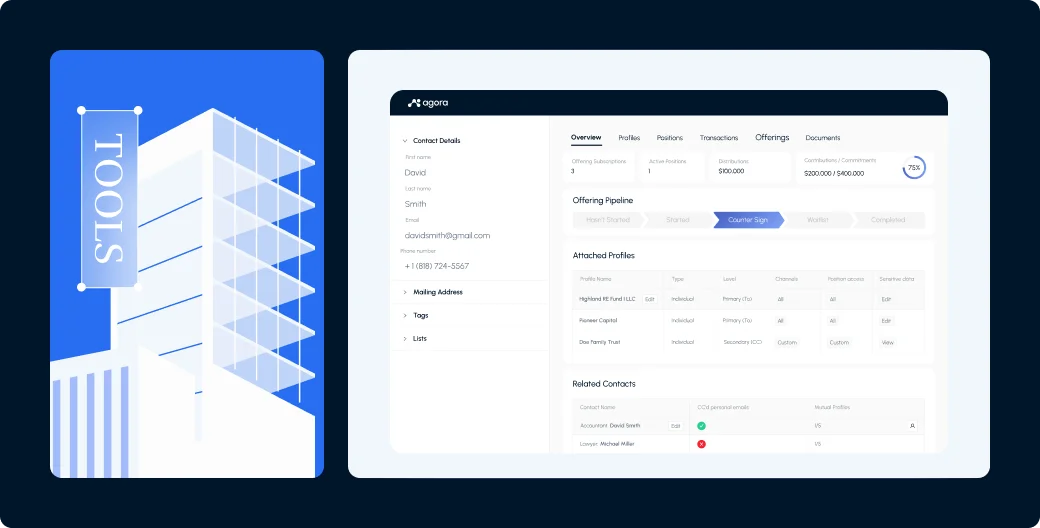
Agora is an all-in-one real estate investment management software with world-class fund accounting capabilities.
Key fund accounting features include:
- Comprehensive financial reporting
- Trustee and lender reports
- Detailed capital account tracking
These features ensure accurate performance metrics while reducing your team’s workload.
Agora’s pricing starts at $749/month for the Essential plan. For pricing on the Pro and Enterprise plans, contact us for a quote.
2. FIS Private Capital Suite
FIS Private Capital Suite (formerly Investran) is a fund accounting software geared toward private equity firms. It promises to simplify your fund accounting with automations and unified systems.
Key fund accounting features include:
- Configurable multiuse portal
- Integrated DocuSign workflows
- Actionable performance insights
- Comprehensive data aggregation
FIS Private Capital Suite doesn’t list its pricing on its website. Contact the company for a quote.

3. Allvue Systems
Allvue Systems is an AI-powered alternative investment software for the full fund lifecycle. While it’s geared toward private equity and venture capital firms, it can also provide accounting for real estate firms.
Key fund accounting features include:
- A true general ledger
- Streamlined accounting workflows
- Seamless integrations across business processes, reports, and allocation methods
- Automated waterfall calculations
Allvue Systems doesn’t list its pricing on its website. Contact the company for a quote.

4. FundCount
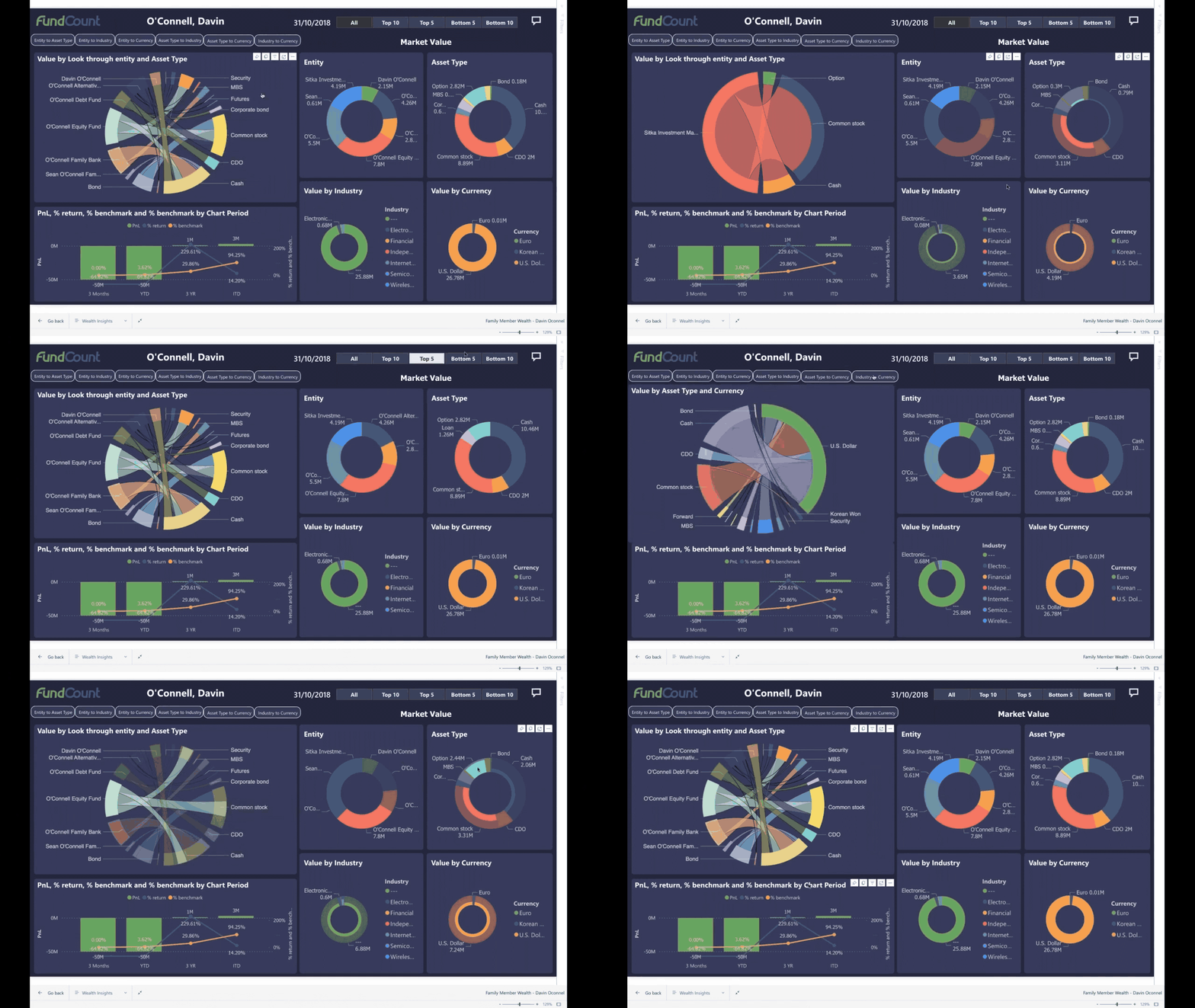
FundCount is a portfolio and partnership accounting software that lets you track complex investments and explain their performance to investors with confidence.
Key fund accounting features include:
- Calculations for NAV, waterfall structures, contributions, and distributions
- Tax reporting
- Customizable on-demand reports
FundCount’s Fund Administration plan starts at $24,449 per year, and its Fund Admin Incubator starts at $5,000 per fund per year (for up to 5 funds and US$50M AUA per fund).
5. NetSuite
NetSuite is an Enterprise Resource Planning (ERP) software with a wide range of applications and industry uses. Among them is real estate accounting.
Key fund accounting features include:
- Customizable dashboards and reports
- Tailored investor statements
- Multi-entity consolidation
NetSuite doesn’t list its pricing on its website. Contact the company directly to get a quote.

6. MRI Software
MRI Software is a property management platform that’s been around since 1971. It has since expanded to offer a variety of software solutions, including real estate investment accounting.
Key fund accounting features include:
- Streamlined contribution and distribution payments
- Comprehensive investor-level performance data
- Tailorable and accurate investor reports
MRI Software doesn’t list its pricing on its website. Contact the company directly to learn more.

7. eFront
eFront is an arm of BlackRock that includes alternative fund administration and accounting software services that cover all alternative asset classes, including private equity, real estate, infrastructure, and private debt funds.
Key fund accounting features include:
- Investment structure mapping
- Fund- and investor-level cash flow and return forecasting
- Automated compliance monitoring
eFront doesn’t list its pricing on its website. Contact the company directly for a quote.

8. Dynamo Software
Dynamo Software is an end-to-end AI-powered platform for the alternative investment ecosystem and includes fund accounting for real estate funds.
Key fund accounting features include:
- Reporting that complies with GAAP, ILPA, or Invest Europe standards.
- Allocation waterfalls
- General partner (GP) accounting
Dynamo Software doesn’t list its pricing on its website. Contact the company for a quote.

9. Backstop Solutions
Backstop Solutions is a comprehensive portfolio management software geared toward institutional investors, private fund managers, and consultants.
Key fund accounting features include:
- Portfolio monitoring across multi-asset class investments
- Investor-level reports on liquidity and performance
- Centralized management of investor relationships
Backstop doesn’t list its pricing on its website. Contact the company directly for a quote.

Fund accounting software comparison overview
Here’s a quick breakdown of the fund accounting software discussed:
| Tool | Core capabilities | Best fit for |
| Agora | Financial reporting, capital account tracking, trustee/lender reports | Real estate funds seeking an all-in-one platform with transparent pricing |
| FIS Private Capital Suite | Multiuse portal, DocuSign integration, performance insights | Private equity firms needing automation and unified systems |
| Allvue Systems | General ledger, accounting workflows, waterfall calculations | PE and VC firms managing full fund lifecycle |
| FundCount | NAV calculations, tax reporting, customizable reports | Firms managing complex investment portfolios needing detailed performance tracking |
| NetSuite | Customizable dashboards, investor statements, multi-entity consolidation | Enterprise-level organizations with diverse industry needs |
| MRI Software | Contribution/distribution management, investor performance data, tailored reports | Property management companies expanding into investment accounting |
| eFront | Investment structure mapping, cash flow forecasting, compliance monitoring | Alternative asset managers (PE, real estate, infrastructure, private debt) |
| Dynamo Software | Industry standard compliance, allocation waterfalls, GP accounting | Alternative investment firms needing compliance-ready reporting |
| Backstop Solutions | Multi-asset class monitoring, liquidity/performance reports, investor relationship management | Institutional investors and consultants managing diverse portfolios |
Key features to look for in fund accounting software
When comparing different fund accounting software options, look for the following:
- Multi-entity and multi-fund accounting support: Look for software that maintains separate financial records for each fund but also consolidated portfolio-level reporting across multiple funds.
- Waterfall modeling and distribution tracking: The software should accurately calculate complex distribution waterfalls to ensure investors receive their correct shares.
- Investor reporting and capital account management: The software should generate transparent return statements and detailed capital account records for each investor.
- Real-time financial visibility and dashboards: Look for customizable dashboards that provide immediate access to key performance metrics so you can make faster decisions.
- Integration with property management and CRM systems: Seek software that integrates with your existing tools and CRM to eliminate manual data entry and errors.
- Audit readiness and compliance support: The software should provide comprehensive audit trails and accurate reporting.
- Automation of allocations, fees, and reconciliations: Prioritize software that automates routine tasks like allocating income and expenses, calculating fees, and reconciling bank accounts.
How to choose the right fund accounting software
To choose the right fund accounting software for your needs, follow these best practices:
| Key consideration | Why it matters |
| Assess your fund structure and reporting complexity | Determine whether you must manage one or multiple funds, the complexity of your waterfall structures, and your regulatory requirements. |
| Evaluate investor communication and reporting needs | Figure out what reporting frequency and format your investors expect. |
| Prioritize automation for distributions and allocations | Prioritize software that automates complex and tedious tasks, such as distributions and allocations. |
| Ensure integration with your existing tech stack | Review your current tools and confirm that your fund accounting software can integrate with them. |
| Consider scalability as your portfolio grows | Choose software that can grow with your business so you don’t have to migrate to another platform later. |
| Compare pricing based on fund size and features | Evaluate pricing models and calculate the total cost of the software, including onboarding and ongoing support. |
Why modern real estate firms are moving to integrated fund accounting platforms
If you’re thinking about moving to an integrated fund accounting platform, you’re not alone. Here’s why many are making the switch:
Shift from siloed tools to unified data environments
Moving away from disconnected tools and spreadsheets eliminates data inconsistencies and the need for manual reconciliations.
Increased demand for real-time investor reporting
Today’s investors expect immediate visibility into their portfolio performance, making real-time dashboards and on-demand financial statements a competitive necessity for attracting and retaining capital.
Growing complexity in fund structures and compliance
As real estate portfolios adopt multiple asset classes and increasingly stringent regulatory requirements, manual accounting methods become impractical.
Need for operational efficiency and automation
Modern fund accounting platforms reduce the time you must spend on repetitive tasks like fee calculations and reconciliations.
How Agora simplifies fund accounting and investor reporting
Agora simplifies fund accounting and investor reporting by providing:
- Comprehensive financial reporting, trustee and lender reports, and detailed capital account tracking
- Accurate and timely capital call calculations, contribution reconciliations, distribution processing, and payments
- Automated onboarding, waterfall tracking, K-1 distribution, AML & KYC compliance, and secure handling of investor contributions, withdrawals, and transfers.
- Comprehensive management reports, NAV-based capital accounts, full audit and tax support, and SEC-compliant quarterly investor reporting
Together, these features allow you to keep investors updated and maintain a transparent fund.
Conclusion
Ultimately, choosing the right fund accounting software is one of the most important decisions you’ll make as a real estate fund manager. Whether you’re managing your first fund or scaling a mature portfolio, the right fund accounting platform can make or break your business.


![Yardi alternatives: Top property management platforms to consider [2026]](https://res.cloudinary.com/de1ep59a0/images/v1776262211/yardi-alternatives/yardi-alternatives.webp?_i=AA)

![10 best accounting software for real estate investors [2026]](https://res.cloudinary.com/de1ep59a0/images/v1772088147/10-best-accounting-software-for-real-estate-investors/10-best-accounting-software-for-real-estate-investors.webp?_i=AA)