

Key Takeaways
- Real estate investment analysis uses systematic evaluation of cash flows, risks, and market conditions to identify profitable opportunities and avoid costly mistakes.
- Key metrics like NOI, cap rate, IRR, and cash-on-cash return provide quantifiable ways to compare properties and measure investment performance.
- Conservative assumptions, reliable data sources, and scenario testing are essential to creating accurate return projections and managing investment risk.
Smart real estate investors don’t just look at properties. They systematically analyze cash flows, risk factors, and market dynamics to separate genuine opportunities from expensive mistakes.
What is real estate investment analysis?
Real estate investment analysis is the systematic process of evaluating a property’s return potential and financial viability. It helps investors make data-driven property buying and selling decisions instead of relying on their intuition or emotions.
Key components of real estate investment analysis
Here are the main components of any real estate investment analysis:
- Property valuation: Determine how much the investment property is worth through one or multiple valuation methods, such as the income, cost, or sales comparison approach. This gives you a baseline for how much to invest.
- Market research and location analysis: Evaluate the property’s market and location to determine its appreciation potential. Look for a growing population, a strong local economy, and attractive amenities nearby.
- Income and expense estimation: Estimate the property’s cash flow by looking at market rents for similar properties nearby, average vacancy rates, and historical operating expenses (property management, maintenance, insurance, taxes, etc.).
- Risk assessment: Carefully weigh market risks (economic downturns, oversupply), property-specific risks (condition, location, tenant quality), financial risks (interest rate changes, refinancing), and regulatory and legal risks (zoning changes, rent control).
Key metrics in real estate investment analysis
When evaluating potential investment opportunities, use these common metrics:
| Definition | Purpose | Formula | |
| Net operating income (NOI) | NOI measures a property’s income after accounting for operating expenses. | Tells you what future cash flow to expect and helps you calculate other valuation metrics | NOI = Gross Operating Income – Total Operating Expenses |
| Capitalization rate (cap rate) | Cap rate measures a property’s annual return without accounting for financing. | Helps you compare the profitability of different investments on a property-level | Cap rate = Net Operating Income (NOI) / Property Price |
| Internal rate of return (IRR) | IRR is an annualized return metric and the discount rate at which the net present value of a property’s cash flows is zero. | Gives you a way to measure a property’s return while accounting for the time value of money. | IRR = Discount rate at which the net present value of the property’s cash flows = 0 (use Excel’s IRR function to calculate) |
| Cash-on-cash return (CoC) | CoC is your annual return on actual cash invested, i.e., after accounting for any financing. | Measures annual return on an investor-level and the impact of different financing options | CoC = Annual pre-tax cash flow / Total cash invested |
| Gross rent multiplier (GRM) | GRM is the ratio of a property’s market value to the annual gross rent it generates. | Helps you quickly evaluate and compare properties in a given market | GRM = Property price / Annual gross rent |
| Debt service coverage ratio (DSCR) | DSCR is a ratio that measures a property’s ability to cover its debt service with its income. | Tells you (and lenders) whether a property generates enough income to cover loan payments | DSCR = Net operating income / Annual debt service |
Steps in conducting real estate investment analysis
For a thorough investment analysis, follow these steps:
1. Define investment goals and risk appetite
First, clarify your investment goals. Do you want to maximize cash flow, appreciation, tax benefits, or portfolio diversification? Furthermore, what’s your timeline, i.e., how long are you planning to hold the investment before refinancing or selling?
Once you’ve established your investment goals, determine how much risk you’re willing to take on to achieve them. Then you can better identify worthwhile investment opportunities.
2. Collect accurate property and market data
With a property in mind, start collecting property and market data, including property financials (rent rolls, operating statements, tax records), inspection reports, legal documents (permits, zoning regulations), and comparable property sales and rental rates (aka comps).
3. Forecast income, expenses, and cash flows
Next, project the property’s future cash flows with the data you collected. This involves analyzing rent rolls and applying realistic rent growth rates, estimating operating expenses based on real quotes, and modeling cash flow by subtracting expected expenses from income.
4. Estimate property value using DCF, comparable, and other methods
To estimate a property’s value, you have options. A discounted cash flow (DCF) analysis applies a discount rate to a property’s future cash flows to determine its present value. Meanwhile, a comparable analysis looks at what similar properties nearby recently sold for.
5. Conduct sensitivity and scenario testing
Test how the investment property would perform under different scenarios. For example, apply different vacancy, rent growth, and expense growth rates. Do the same for different exit cap rates and holding periods. Then construct a worst-case and best-case scenario for the investment.
6. Evaluate financing and exit strategies
Finally, compare the impact of different financing and exit strategies on returns. For example, model different loan structures (fully amortized or interest-only) and terms (5-, 10-, 20-year) as well as different exit methods (sale, refinance).
Additionally, consider developing commercial real estate liquidity strategies that give you flexibility to access capital when needed, such as structuring refinancing options or establishing lines of credit against property equity.
Common challenges and pitfalls in real estate investment analysis
Avoid these common mistakes when analyzing potential real estate investments:
- Overestimating rental potential: Overly optimistic rents can inflate your return projections. Common culprits include ignoring lease-up time for new tenants and not factoring in any rent control or regulatory caps.
- Ignoring hidden costs and vacancies: Underestimating operating or vacancy costs can also inflate your projected returns. Commonly missed expenses include turnover costs, capital expenditures, and property management fees.
- Using outdated or limited data sources: Poor data sources can skew your return projections and even lead to losses. Always verify seller-provided financials and don’t rely on any outdated information.
- Over-leveraging financing: Taking on excessive debt relative to the property’s income can jeopardize your investment. Protect against over-leveraging with cash reserves and conservative income projections.
- Inconsistent financial assumptions across properties: Applying varying discount rates or mixing analysis timeframes can cloud your investment analysis and make it harder to compare properties.
- Neglecting legal and tax aspects: Failing to account for liens or title issues, missing zoning restrictions or code violations, or ignoring the tax implications of an investment property can hurt its performance.
Best practices for real estate investment analysis
To help ensure your investment analysis is sound, follow these best practices:
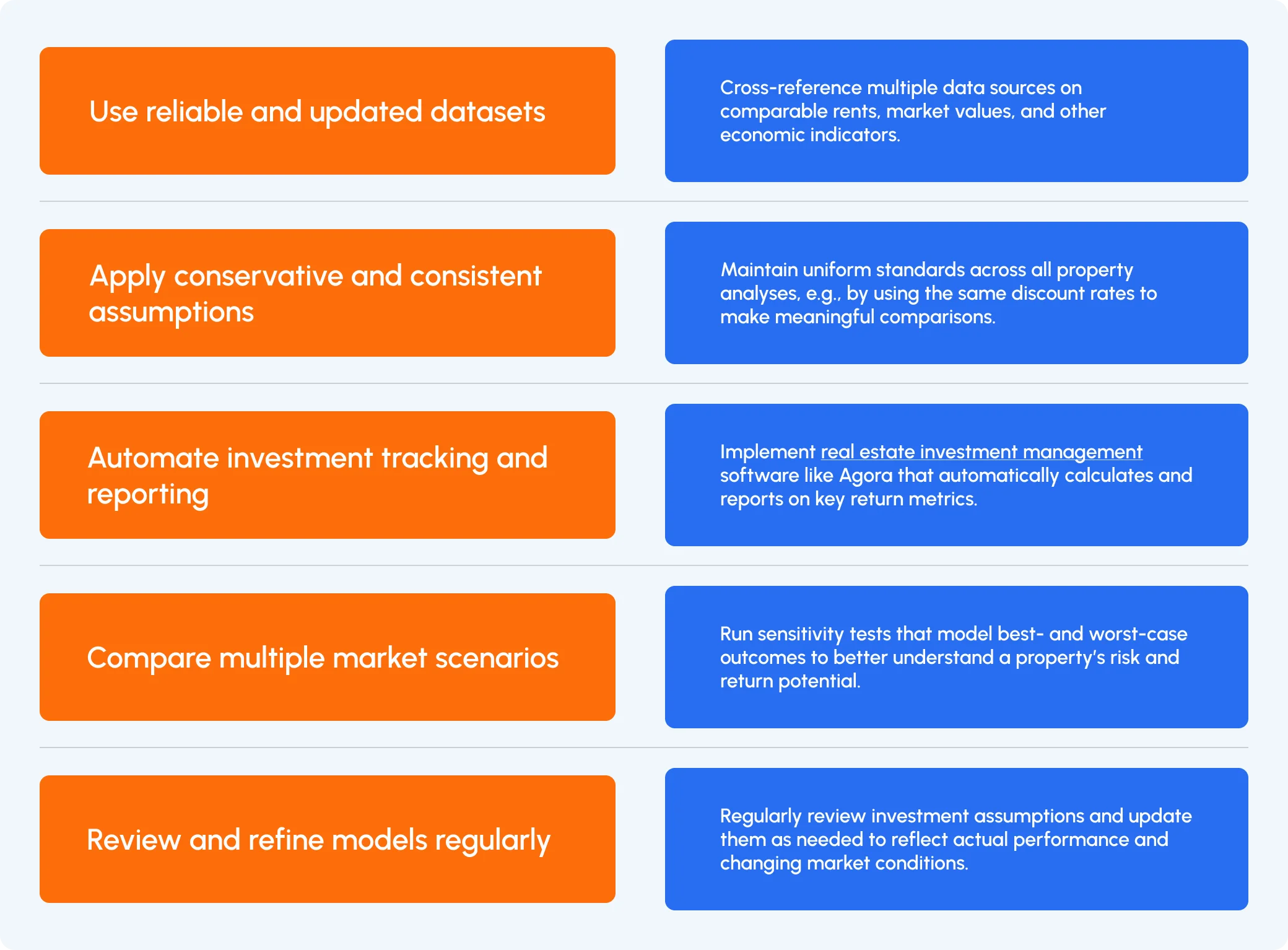
Technology and tools for real estate investment analysis
Fortunately, you don’t need to do your investment analysis by hand. Purpose-built software like the following can streamline the process:
Automation and AI in financial modeling
Instead of relying on spreadsheets for financial modeling, use dedicated AI to automatically extract data from documents and listings, build dynamic financial models, and forecast returns.
Real estate analytics and visualization tools
Real estate analytics platforms with built-in visualization tools can make it easier to monitor investments at a glance. Think real-time dashboards, heat maps, and charts.
Centralized portfolio management and reporting platforms
Centralized portfolio management and reporting platforms make it easier to manage your investments from one place, collaborate with multiple users, and keep data secure in the cloud.
How Agora simplifies real estate investment analysis
Looking for a one-stop shop for all your investment analysis needs? Try Agora. It can help you manage your entire portfolio on the cloud, keep up with real estate investor relations, maintain proper accounting, and much more.
Whether you’re looking to analyze a single deal or build a repeatable due diligence workflow, Agora can streamline the entire process.
Conclusion
Ultimately, effective real estate investment analysis is the foundation of successful real estate investment strategies. By combining robust data, conservative assumptions, and the right tools, you can make more confident decisions that align with your financial goals and risk tolerance.