
Key Takeaways
- A PE-specific CRM consolidates investor relationships, deal tracking, and fund reporting into a single platform, eliminating the need for multiple disconnected systems.
- The right CRM automates routine tasks like distributions and capital calls, freeing up your team to focus on building investor relationships and executing deals.
- Choosing a CRM designed for private equity ensures you have built-in workflows for fund management, compliance, and investor communications from day one.
If you own or manage a real estate private equity fund, you know the importance of using a reliable customer relationship management (CRM) platform. Without one, you’re often flying blind, trying to manage investors and track fund performance.
That’s why we compiled a list of the top ten CRMs for private equity firms. Read on to explore software options that can help you avoid letting investors and deals fall through the cracks.
10 best CRM for private equity firms to manage investors and deals
Here are the top ten CRMs for private equity firms in 2026:
1. Agora
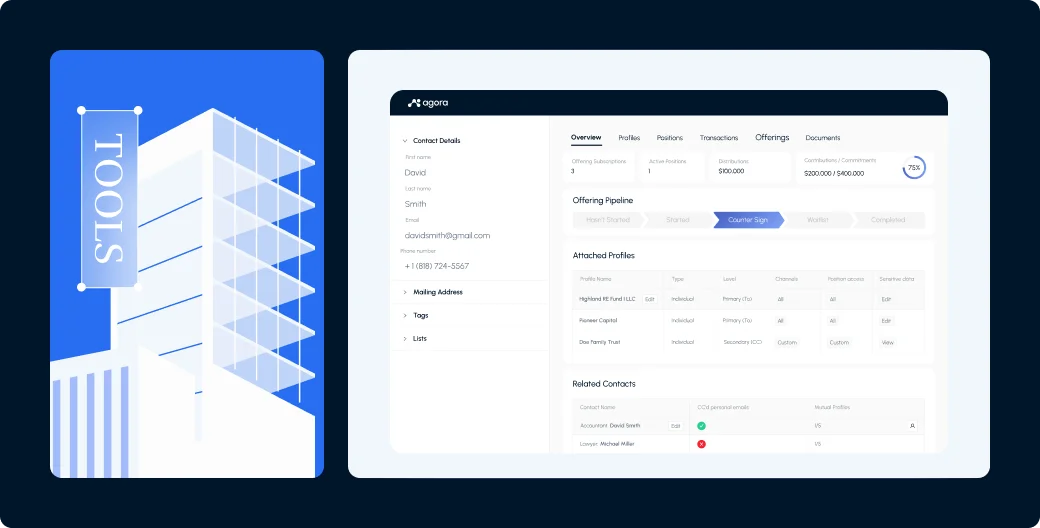
Agora is a comprehensive investment management platform with a built-in CRM that provides instant access to all investor information, from initial contact to communications to reporting.
Key CRM features include:
- Complete management of the investor lifecycle
- Instant access to investor data and documents
- Streamlined investor communications
- Comprehensive document management and reporting
Agora’s pricing starts at $749 per month for the Essential Plan. For pricing on the advanced Pro and Enterprise plans, contact us for a quote.
2. Salesforce Financial Services Cloud
Salesforce Financial Services Cloud is an AI-powered CRM geared toward financial services like banks, wealth managers, and insurance companies. However, private equity firms can adapt it to their needs as well.
Key CRM features include:
- Autonomous AI agents that can reason, adapt, and act
- Built-in compliance via data control, guardrails, and testing
- Performance analytics
- Integrations for further scalability
Salesforce Financial Services Cloud pricing depends on which package you choose. The Financial Services Cloud for Sales, Service, or Sales and Service starts at $325/user/month, while the Financial Services Cloud Agentforce 1 Sales and Financial Services Cloud Agentforce 1 Services cost $750/user/month.

3. DealCloud
DealCloud is a deal and relationship intelligence platform for professional firms. It’s designed to drive smarter origination, stronger execution, and faster growth.
Key CRM features include:
- Fundraising
- Deal sourcing and screening
- Diligence and investment committee prep
- Exit execution
DealCloud pricing isn’t listed on its website. Contact the company directly for a quote.

4. Dynamo Software
Dynamo Software is an end-to-end cloud platform for private equity firms, venture capital firms, and other alternative investment firms. It empowers you to manage investors and drive deals to the finish line.
Key CRM features include:
- Full lifecycle visibility from initial research to post-investment
- Real-time relationship visibility for smarter collaboration
- Intelligent data processing and AI insights
Pricing for Dynamo Software isn’t listed on its website. Contact the company directly for a quote.

5. Affinity
Affinity is a CRM built specifically for private capital. It’s designed to automate your investment and deal management, giving you time back for the work that actually requires you.
Key CRM features include:
- Relationship intelligence and analytics
- Automatic data capture
- Purpose-built workflows for managing deal flow and LPs
Affinity’s pricing is $2,000/user/year for the Essential plan, $2,300/user/year for the Scale plan, and $2,700/user/year for the Advanced plan. To learn the cost of the Enterprise plan, contact the company directly.

6. HubSpot
HubSpot is a general CRM tool that can be used in nearly any industry. With the right custom PE workflows, you can use it to manage your investors and deal flow.
Key CRM features include:
- Contact management
- Activity tracking
- Pipeline management
- Reporting dashboard
HubSpot offers a free version, a Starter plan for $15/month/seat, a Professional plan for $50/month/seat, and an Enterprise plan for $75/month/seat.

7. Pipedrive
Pipedrive is a lightweight CRM that lets you track your sales pipeline, optimize leads, manage deals, and automate your entire sales process so you can focus on selling.
Key CRM features include:
- Notifications to identify client patterns and opportunities
- AI email generator
- Email summaries
- Sales reports
Pipedrive has tiered pricing. It’s $14/seat/month for the Lite plan, $39/seat/month for the Growth plan, $59/seat/month for the Premium plan, and $79/seat/month for the Ultimate plan (billed annually).

8. Altvia
Altvia is a leading private capital tech platform with a CRM designed to unlock productivity, strengthen relationships, and accelerate outcomes.
Key CRM features include:
- Centralized data management
- Automated data entry
- Data trend visualizations
- AI assistant
Altvia doesn’t list its pricing on its website. Contact the company directly for a quote.

9. Navatar
Navatar is an AI Deal Engine built for private equity. It brings together public information, subscribed third-party data, and firm knowledge into a single platform.
Key CRM features include:
- Deal screening and early due diligence
- AI insights
- Investor relations and fundraising
Navatar’s pricing isn’t listed on its website. Contact the company directly for a quote.

10. Satuit Technologies
Satuit Technologies is a CRM that streamlines fundraising, investor relations, deal flow, and portfolio management within a single, intuitive platform.
Key CRM features include:
- Deal flow pipeline management
- Deal financials
- Document management
- Email integration
- Third-party list import
Satuit Technologies’ pricing starts at $150 for the Essentials plan, $200 for the Premium plan, and $300 for the Enterprise plan.

Private equity CRM comparison overview
Now, here’s a quick CRM comparison overview:
| CRM platform | Primary focus (IR, deal management, or full platform) | Fund and deal tracking | Best fit for |
| Agora | Full platform | Yes | PE firms needing complete investor data access and reporting |
| Salesforce Financial Services Cloud | Full platform | Yes | Enterprise PE firms with complex compliance and scalability needs |
| DealCloud | Deal management | Yes | Firms focused on deal origination and execution |
| Dynamo Software | Full platform | Yes | PE firms managing complex alternative investments |
| Affinity | Full platform | Yes | PE firms seeking relationship intelligence and workflow automation |
| HubSpot | General/customizable | Yes | Budget-conscious PE firms or those seeking a lightweight CRM |
| Pipedrive | Deal management | Yes | PE firms needing simple, affordable deal tracking |
| Altvia | Full platform | Yes | PE firms prioritizing data automation and AI-assisted insights |
| Navatar | Deal management | Yes | PE firms seeking AI insights for deal evaluation and investor relations |
| Satuit Technologies | Full platform | Yes | PE firms needing integrated fundraising, investor relations, and deal management |
What to Look for in a Private Equity CRM
When evaluating CRM platforms for commercial real estate private equity, look for the following:
Investor relationship management
A quality PE CRM centralizes all LP data in one place, so you can track relationships from initial contact through exit. This includes automated investor communications, workflow automations for investor onboarding, and streamlined capital call and distribution tracking.
Deal pipeline and opportunity tracking
Your CRM should provide deal and pipeline visibility across your entire team, so stakeholders can see opportunities at every stage of the investment lifecycle. This helps ensure deals don’t fall through the cracks.
Fundraising and capital activity management
A comprehensive PE CRM tracks all fundraising and capital activity, including capital calls, distributions, and investor commitments. This keeps your real estate capital raising efforts organized and ensures you can report on capital deployment in real time.
Reporting and Compliance
The platform should include custom reporting dashboards and compliance features like audit trails and data security. Secure document sharing and fund accounting are also essential for securely managing investors’ information.
Operational Efficiency
The best real estate investor CRMs automate routine tasks like investor onboarding and updates. This frees up more time to focus on building relationships and executing deals. Also, look for platforms that integrate with your existing tech stack, so you can hit the ground running.
How to choose the right CRM for your private equity firm
To choose the right CRM for your PE firm, follow these steps:
| Key consideration | What to look for |
| Define your primary use case | Start by identifying whether your firm’s primary need is investor relations management, deal tracking, or a comprehensive platform that handles both. |
| Evaluate scalability across funds and portfolios | As your firm grows and launches new funds, your CRM should be able to handle multiple funds and investment portfolios without requiring significant reconfiguration. |
| Prioritize ease of use for internal teams and investors | A CRM with an intuitive interface will be easier for your team to learn and adopt. |
| Assess integration with existing fund and reporting systems | Verify that the CRM integrates seamlessly with your current fund accounting software, reporting tools, and other software to avoid manual data entry. |
| Consider customization vs. out-of-the-box functionality | Determine whether a CRM that requires significant customization to match your workflows is worth the implementation time and cost, or if an out-of-the-box solution is better. |
| Compare pricing models based on firm size and complexity | Evaluate whether per-user pricing, tiered plans, or custom enterprise pricing aligns with your budget and firm size. |
How Agora’s CRM supports investor management
Agora’s CRM makes keeping track of your investor relationships easy. It includes:
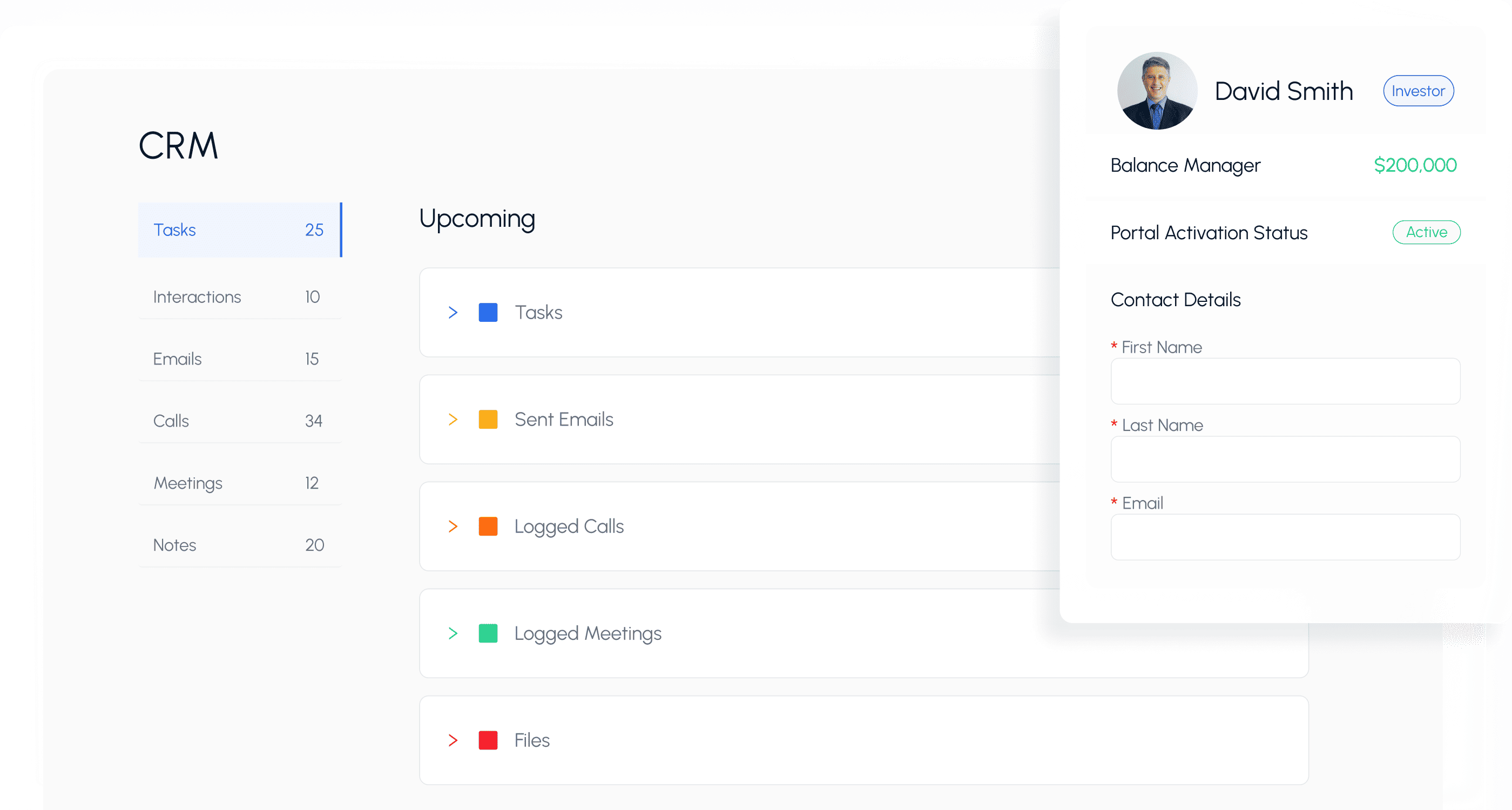
- Complete management of the investor lifecycle: Streamline all aspects of investor management, from lead to active investor. Effortlessly manage fundraising, distributions, payments, and reporting from one centralized platform.
- Instant access to investor data and documents: Easily access all investor information and documents, including commitments, distributions, communications, and contact details in one place. Customize your investor management with a CRM that allows tailored data fields and custom views.
- Streamlined investor communications: Track, log, and categorize all investor communications, including email, phone calls, and requests from one platform. Automatically generate and send distribution notices and signature requests directly to investors.
- Comprehensive document management and reporting: Access all relevant investment and tax documents, including distribution notices, K-1s, subscription agreements, and quarterly reports, anytime. Effortlessly send custom-made updates and professionally branded reports to your investors and streamline your workflow.
Conclusion
Ultimately, the CRM you choose for your private equity firm can make a big difference. Whether you’re managing a single fund or multiple funds, the right platform can streamline your investor relationships and deal execution. Start by exploring some of the private equity CRM software options listed above, and pick the one that best meets your firm’s needs.


![Yardi alternatives: Top property management platforms to consider [2026]](https://res.cloudinary.com/de1ep59a0/images/v1776262211/yardi-alternatives/yardi-alternatives.webp?_i=AA)

![10 best accounting software for real estate investors [2026]](https://res.cloudinary.com/de1ep59a0/images/v1772088147/10-best-accounting-software-for-real-estate-investors/10-best-accounting-software-for-real-estate-investors.webp?_i=AA)