




Artificial intelligence adoption continues to grow in the real estate industry. The Business Research Company predicts a CAGR of 33.9% through 2030. Use cases range from automating tasks in property and asset management to evaluating market data for investment strategy.
Capital raising is central to growing a firm, and AI is changing how GPs do it. When everyone is competing for the same capital, automating investor follow-up and onboarding is one way to stand out. The right software gives GPs a competitive edge.
Below, we cover the top AI for real estate fundraising tools to support data analysis, investor presentations, onboarding, and long-term relationships.
10 best AI tools for real estate fundraising
Here are the best AI tools for raising capital in commercial real estate.
1. Agora
Agora is an investment management platform built exclusively for commercial real estate, used by GPs from emerging firms to large investment managers. It handles multiple fund types and structures, including cross-border deals that add currency and regulatory complexity.
Key features:
- Capital-raising pipeline: Tracks investors, commitments, and funding across custom stages that match your fundraising process. Investors move automatically from soft commitment to subscription to funding, and teams can send follow-ups, grant data room access, or invite investors to subscribe without leaving the fundraising pipeline.
- Investor onboarding: Turns subscription documents into an interactive Smart Questionnaire that prefills from the investor’s profile, collects accreditation and KYC, and adapts the subscription flow to regulatory requirements.
- Data rooms and landing pages: Hosts branded data rooms and deal landing pages where investors review offerings, key metrics, documents, and visuals.
- Fundraising CRM: Manages investor relationships, tracks prospects from first interest to subscription, segments investors by type, and uses AI technology to alert on areas that need attention.
- Investor reporting and updates: Delivers performance reports, K-1s, capital account statements, and fund updates to each investor through an investor portal throughout the life of the investment.
Pricing: Agora’s pricing starts at $749/month for the Essential plan, with Pro and Enterprise plans available for additional capabilities.

2. Visible
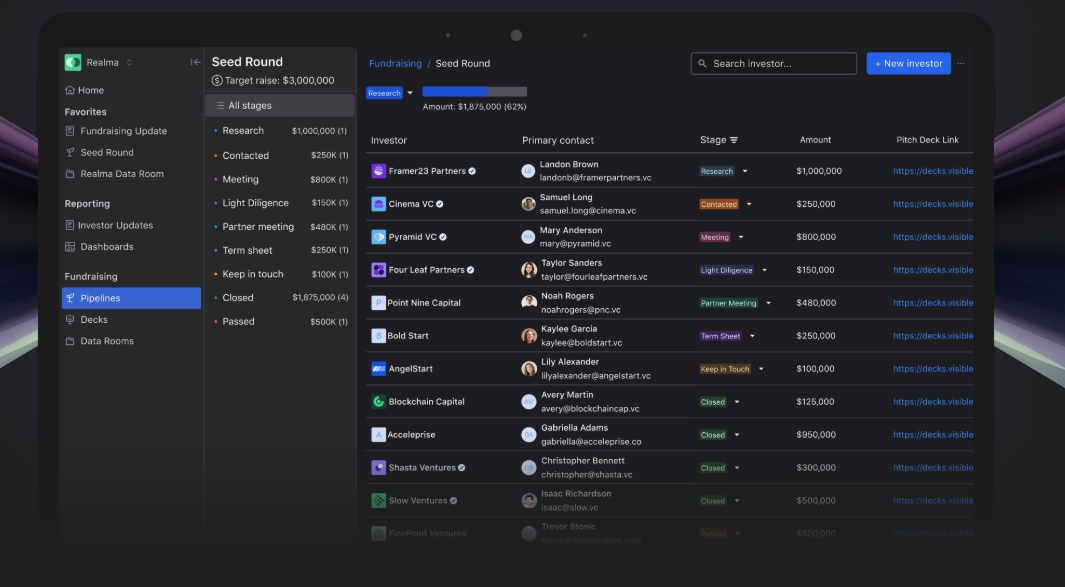
Visible is a fundraising platform built for startup founders raising capital and managing investor reporting.
Key features:
- Fundraising CRM: Tracks the investor pipeline, syncs investor communication, and uses AI to parse investor updates into structured data.
- Investor discovery: Searches a database of investors by focus, stage, geography, and check size, and adds them to the pipeline.
- Pitch deck sharing: Hosts multiple presentation versions and records who opened each one, how long they spent, and which slides they viewed.
Pricing: Visible offers a free Starter plan to support investor updates and early fundraising. Paid plans include Base at $69/month, Core at $149/month, and Growth at $249/month.
3. Dealpath
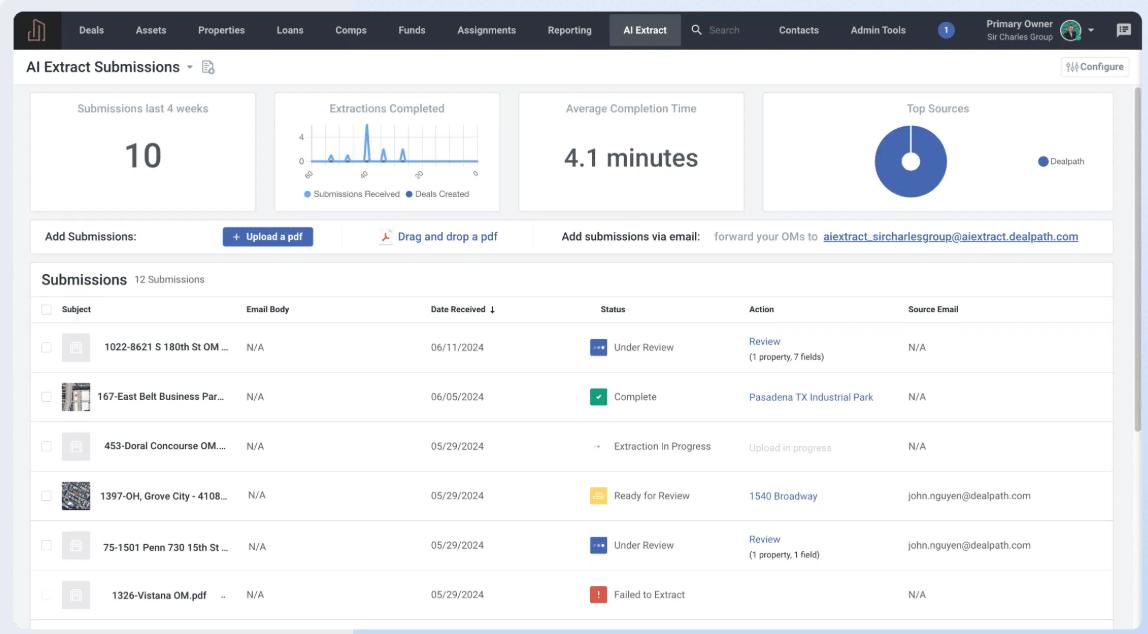
Institutional real estate investors and CRE investment teams use Dealpath to manage deal acquisitions.
Key features:
- Deal pipeline: Tracks real estate deals from sourcing through close and manages workflows for complex debt and equity transactions.
- AI data extraction: Pulls property and deal data from offering memos and flyers automatically for scenario analysis and deal evaluation.
- Proprietary property database: Aggregates deal and property data into a searchable database that informs investment decisions.
Pricing: Dealpath doesn’t list public pricing. It offers two plans, Professional and Enterprise, with custom pricing that depends on firm size and needs.
4. Altvia
Altvia is a fundraising and investor relations platform for GP teams at alternative investment firms, including private equity, real estate, venture capital, and private credit.
Key features:
- Fundraising CRM: Tracks LP engagement across the pipeline, automates follow-ups, and centralizes contact history and relationship context.
- LP targeting: Identifies LPs by past commitments, interests, and activity, and alerts on open fundraising opportunities against each LP profile.
- Salesforce-based platform: Manages LP relationship management and investor communication on Salesforce through its AIMPro solution.
Pricing: Altvia does not list pricing publicly. Contact sales for a quote.

5. Dynamo Software
Private equity, real estate, hedge fund, and venture capital firms use Dynamo Software to manage fundraising and investor relationships.
Key features:
- Fundraising CRM: Tracks investor relationships and preferences, manages the pipeline with configurable filters, and auto-tags activity using artificial intelligence.
- Investor prospecting: Integrates Preqin and PitchBook directly into the CRM to find and qualify new investors.
- Investor portal and onboarding: Provides a portal where investors access materials and e-sign documents through DocuSign to finalize their commitments.
Pricing: Dynamo does not list pricing on its website. Contact sales for a quote.

6. Backstop Solutions
Backstop Solutions serves institutional allocators, consultants, and asset managers, from pension funds and endowments to hedge funds and private equity firms.
Key features:
- Investor relations CRM: Manages investor communications and relationships, tracks engagement, and provides a portal for messaging and reporting.
- Research management: Centralizes investment research and due diligence, with tools to organize, evaluate, and share materials.
- Mobile access: iOS and Android apps for viewing opportunity details and updating contact records.
Pricing: Backstop provides pricing on request through its sales team.

7. Affinity
Affinity applies relationship intelligence to fundraising for private equity and venture capital firms, their IR teams, and family offices.
Key features:
- Relationship intelligence: Captures every email and meeting automatically and maps the firm’s network to reveal warm paths to LPs.
- AI-powered LP discovery: Uses AI to flag the LPs most likely to commit based on interaction history, and answers questions across the fundraising pipeline.
- Fundraising pipeline: Manages LP commitments through each stage on Kanban boards with automated status updates.
Pricing: Affinity prices per user, per year. Plans include Essential at $2,000, Scale at $2,300, and Advanced at $2,700, with a custom Enterprise plan available.

8. Northspyre
Real estate developers and building owners use Northspyre to manage the financial side of development projects from pre-construction through completion.
Key features:
- Capital management: Tracks project spend across pre-development, construction, and completion, with budget forecasting and centralized financial data.
- Project management: Automates manual development workflows and vendor procurement.
- Portfolio analytics: Monitors project performance, returns, and potential risks across a development portfolio.
Pricing: Northspyre offers Pro and Enterprise plans. Contact sales for a quote.

9. Satuit Technologies
Satuit Technologies provides investor relationship management and reporting software for institutional asset managers, hedge funds, private equity firms, and family offices.
Key features:
- Investor CRM: Identifies, onboards, and manages investor relationships, with built-in compliance tracking.
- Investor portal: Gives investors centralized access to account data, documents, performance history, and transaction records, under the firm’s branding.
- Client reporting: Automates the compilation of investor reports from account and performance data.
Pricing: Satuit offers three plans, all per user per month: Essentials at $150, Premium from $200, and Enterprise from $300.

10. Navatar
Navatar is a Salesforce-based fundraising and investor relations platform for private equity firms, hedge funds, investment banks, and other alternative asset managers.
Key features:
- Fundraising workflow: Targets LPs and tracks investor interactions through each stage of the raise.
- LP portal and data room: Provides investors access to documents and data through virtual data rooms for due diligence.
- AI-powered CRM: Connects deal and relationship data, integrates with Microsoft Copilot, and automates data entry.
Pricing: Navatar provides pricing by request. Contact sales for a quote.

AI tools for real estate fundraising comparison overview
Here is an at-a-glance comparison of these tools and their key generative AI capabilities:
| Tool | Primary use case | Key AI capabilities |
Best for |
| Agora | Fundraising and investor management for commercial real estate | AI alerts in the CRM flag investors needing attention to keep capital raising on track | Real estate GPs and owner-operators, boutique to enterprise |
| Visible | Fundraising and investor updates | Parses investor updates into structured data | Startup founders raising capital |
| Dealpath | Real estate deal sourcing and pipeline management | Extracts deal data from offering memos and flyers | Institutional real estate investors and CRE deal teams |
| Altvia | Fundraising and investor relations for alternative-investment GPs | Generates deal insights and auto-fills CRM activity | GP teams at PE, real estate, VC, and private credit firms |
| Dynamo Software | Fundraising and investor management for alternatives | Auto-tags contacts and summarizes documents and interactions | Alt-investment GPs across PE, real estate, hedge funds, VC, and fund of funds |
| Backstop Solutions | Investor relations and investment research for allocators | Document and data extraction | Institutional allocators, consultants, and asset managers |
| Affinity | Relationship-intelligence CRM for fundraising | Highlights the LPs most likely to commit and provides pipeline insights | PE and VC firms, IR teams, and family offices |
| Northspyre | Financial management for real estate development projects | Flags overruns in budgets and project costs | Real estate developers and building owners |
| Satuit Technologies | Investor CRM and client reporting for buy-side managers | CRM and reporting automation | Institutional asset managers, hedge funds, PE firms, and family offices |
| Navatar | Fundraising and investor relations on Salesforce | Workflow automation and data capture | PE firms, hedge funds, investment banks, and alt asset managers |
How AI is changing real estate fundraising for GPs
Raising capital for real estate investing involves follow-up and paperwork. AI automates and enhances the process with the following capabilities:
- Automating investor outreach and pipeline management: Tracks each investor’s status in the raise and triggers the right follow-ups, reminders, and next steps. It replaces manual spreadsheet tracking across soft commitments, subscriptions, and funded capital.
- AI-assisted subscription document processing and onboarding: Reads subscription documents and turns them into guided questionnaires that prefill investor data, collect accreditation and KYC, and alert on missing information.
- Predictive analytics for identifying and prioritizing LP prospects: Scores prospects by past commitments, engagement, and behavior, showing which LPs are most likely to commit. GPs can then focus on the relationships with the highest chance of closing.
- Automated reporting and document delivery to investors: Assembles and routes investor reports, capital account statements, and tax documents like K-1s to the correct investor without manual intervention.
AI use cases across different real estate investment models
AI can support fundraising for all types of structures, including:
- Commercial real estate funds: With multiple LPs and assets to report on, AI generates capital account statements, distribution notices, and K-1s on a set schedule.
- Real estate syndications: Syndicators raise deal by deal, so AI speeds onboarding with prefilled subscriptions and accreditation checks, then tracks soft commitments through to funding.
- Private equity real estate firms: AI scores and prioritizes LP prospects by commitment history and engagement, and produces the institutional reports larger investors expect.
- Crowdfunding platforms: These platforms onboard many investors, so AI handles KYC, AML, and identity checks at scale and segments a large investor base for targeted communication.
- REITs and institutional investors: For large, complex holdings, AI supports portfolio analytics, performance forecasting, and compliance reporting.
Essential features to look for in AI tools for real estate fundraising
Key criteria to consider when choosing an AI fundraising tool:
|
Feature |
Impact |
| Fundraising pipeline management and deal tracking | Visibility into every commitment from first outreach to funded capital |
| Digital subscription processing and investor onboarding automation | Faster onboarding with less manual document handling and fewer errors |
| Investor CRM with AI-assisted relationship tracking | Prioritized outreach toward the investors most likely to commit |
| Data room management and document delivery | Secure, on-demand access to offering materials with tracking of who viewed what |
| KYC, AML, and accreditation verification | Automated compliance checks to keep your firm audit-ready as you scale |
| Investor portal with real-time reporting and communication tools | Self-service access to performance and other insights that reduces inbound investor requests |
| Waterfall automation and distribution management | Accurate and traceable distribution calculations across complex structures |
How to choose the right AI tool for real estate fundraising
These five steps can help you assess and compare your options:
- Assess your fund structure and LP relationship complexity: Look for a tool that handles your current fund types, waterfalls, and LPs. It should also support your future growth plans, so you don’t have to switch platforms later.
- Evaluate onboarding and subscription workflow automation depth: Tools vary widely in how much of the subscription process they automate. Prefilled documents, embedded accreditation, and guided questionnaires move investors from interest to funded faster than one that automates only part of the flow.
- Prioritize platforms with built-in compliance and accreditation tools: Native KYC, AML, and accreditation verification keep onboarding compliant without adding a separate service. As your fund grows and reporting obligations increase, built-in tools handle the added regulatory work.
- Consider integration with existing accounting and CRM systems: The tool should connect to the accounting, property management, and CRM systems you already use. Integrated tools keep investor and financial data consistent and avoid manual reconciliation across platforms.
- Look for investor portal and reporting capabilities that scale with AUM: Choose a solution that includes an investor portal that offers self-service access and centralized reporting. It should support a growing AUM, LP count, and number of funds.
Conclusion
Choosing the right fundraising platform involves understanding your requirements, evaluating your options, and making a choice that supports your long-term growth. Check reviews, look into onboarding support, and talk with current customers to make the best decision for your firm.
Learn more about how Agora helps you raise capital faster with AI and automation.






![10 best investor reporting software for real estate [2026]](https://res.cloudinary.com/de1ep59a0/images/v1781175724/Best-investor-reporting-software/Best-investor-reporting-software.webp?_i=AA)

